
Triathlon strength training guide · 10 min read
Strength training for the triathlete: the 4th pillar of your progression
Swim, bike, run. Think triathlon is just three disciplines? There's a fourth one, and it changes everything. Strength training is what makes your body capable of handling the hours of training, going faster at every pace, and staying ready and injury-free season after season. No need to lift heavy from day one, or to have grown up in a gym. A few well-chosen exercises, a solid core, and consistency are all it takes to transform your practice.
This guide explains why you should start, where to begin, how many sessions to maintain, and how to build your strength over the whole season.
Why strength training is the 4th pillar of triathlon
You train in three disciplines, but you progress thanks to four pillars. Strength conditioning is the fourth, and it supports the other three. The heart and lungs matter immensely, of course. But it's your muscles that move you forward: the stronger they are, the more speed you generate, on your easy rides just like on your accelerations.
The second benefit is even more valuable, especially when you're starting out: getting stronger protects your body. A muscular body better withstands the repeated stress of swimming, cycling, and running. That's what allows you to train consistently and hold your posture when fatigue sets in on the second half of the race. In this area, strength training does much more for you than stretching.
Takeaway: Your muscles decide your speed, and consistency brings progression. Strength training impacts both.
Strength training, conditioning, core work: what are we talking about
These three terms come up often, so let's clarify them.
- Muscular conditioning is the broad term: making your muscles stronger to swim, bike, and run better. Strength training is its most structured form, with or without weights.
- Strength is what you build in phases, at specific times in your season. It's periodized (we'll come back to this below).
- Core work is the solidity of your entire trunk, from armpits to groin. This belt stabilizes your spine, supports your shoulders and hips, and transfers power between your arms and legs. Unlike strength, core work isn't periodized: it's maintained continuously, all year round.
A well-supported core helps you everywhere: it keeps your body aligned in the water, stabilizes your pelvis on the bike so your power goes into the pedals, and maintains your running posture when your legs get tired.
Where to begin: your first bodyweight exercises
Good news: you don't need anything to get started. Your own bodyweight is more than enough. The goal isn't to lift heavy, but to learn to move correctly and wake up the muscles that will carry you in the water, on the bike, and on the road.
Four families of movements cover the essentials:
- Squatting: going down as if to sit, back straight, knees aligned with your feet.
- Lunges: one step forward, bend both knees.
- Step-ups: stepping onto a stable box or step, one leg at a time.
- Modified push-ups: on your knees or against a wall if needed.
These movements mimic the motions you already make while cycling and running, making their strength directly applicable.
Posture trumps everything else. A perfect bodyweight squat is much better than a heavy, poorly executed one. Move slowly, control the descent as much as the ascent, and engage your core on every rep. And always place your strength conditioning after a swim, bike, or run session, never before: lifting beforehand would fatigue your muscles and ruin your form on the session that matters most.
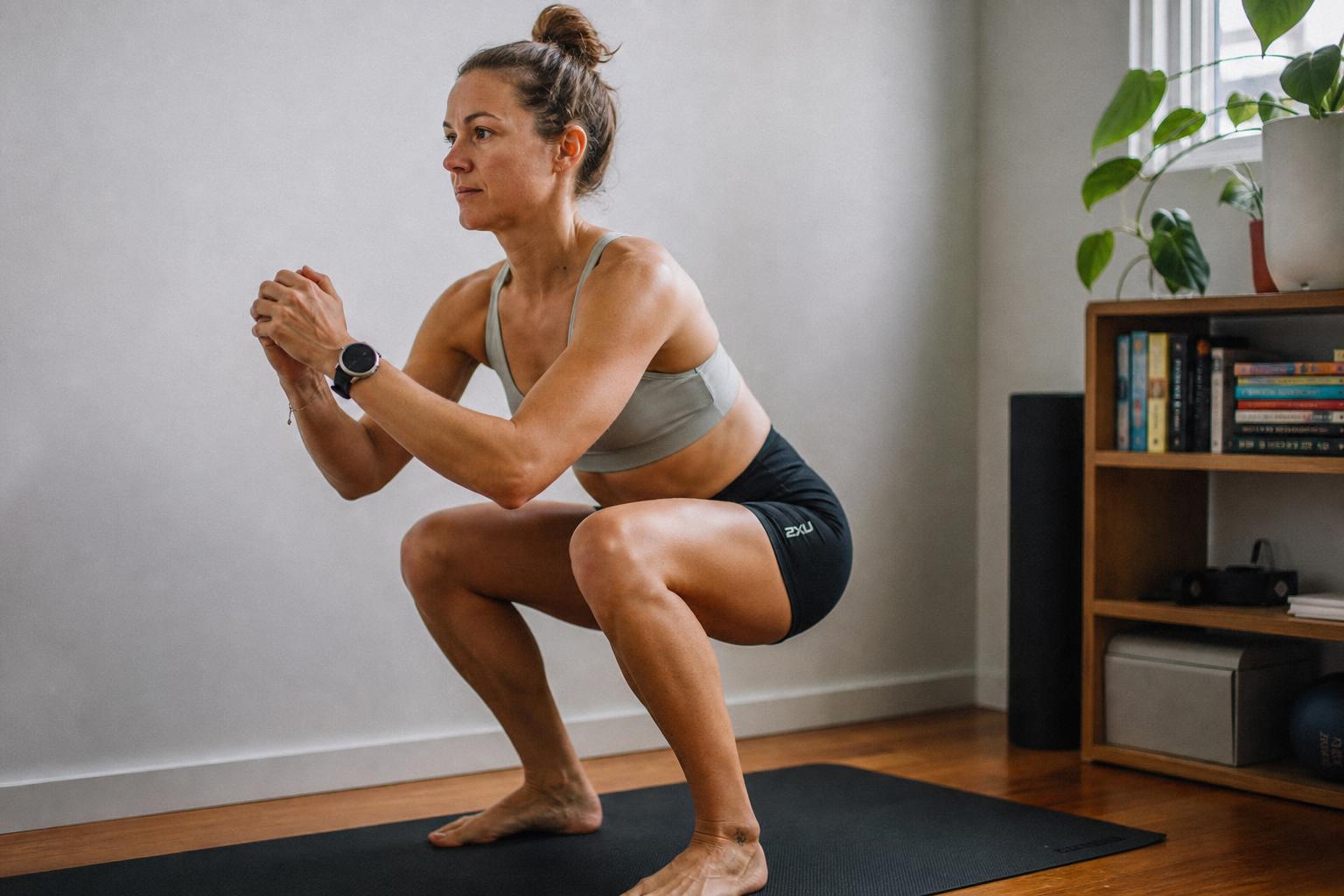
Basic vocabulary
- Repetition (Rep): one complete movement (a squat down and back up).
- Set: a group of continuous reps done without stopping (e.g., ten squats in a row).
- Load: the resistance you move. At first, it's just your body weight.
- Recovery: the rest time between two sets.
With these four words, you can follow any program.
How many strength sessions a week
You don't need to live at the gym. Just one short session a week is already enough to reap most of the benefits, while keeping the priority on your three disciplines. Consistency matters more than intensity: it's the gentle repetition, week after week, that builds durability.
Three guidelines to dose it right without burning out:
- Stop each set one or two reps before failure (when you can no longer do it). The gain is almost the same as going to complete failure, but with far less risk and a much quicker recovery.
- Progress in small steps, never all at once: a bit more load, one more rep, a slightly more demanding variation. A sudden jump is the best way to trigger an injury.
- Bookend your session in three parts: warm-up (a few minutes of light cardio then unweighted movements), main workout, short cool-down. Lifting cold exposes you to injury.
Building your strength program across the season
Lifting weights randomly all year long doesn't build much. Real strength is built in phases, scheduled at the right time. This is called strength periodization, and it consists of four stages:
- Anatomical adaptation: you get familiar with the movements, wake up your tissues, and nail down your technique with reasonable loads.
- Transition: you gradually increase to heavier loads to prepare your body.
- Maximum strength: the core of the work. Heavy loads, few reps. This is where you really build your strength.
- Maintenance: you keep the gains with very low volume, leaving room for your specific triathlon sessions.

Build early, maintain later
Strength is built early in the season, during prep and early base phases, when your swim, bike, and run sessions demand little time and the pressure for performance is low. The further the season progresses, the more demanding your specific sessions become: that's no longer the time to tackle a big strength block. Think of your strength like foundations. You pour them at the beginning, once and for all, and then build on top of them.
The golden rule of the week: never combine a heavy strength load and a heavy specific training load at the same time. When you build heavy strength, your triathlon sessions should be held back. When you push hard on specific sessions, your strength goes into simple maintenance mode. You can orchestrate all this in your triathlon training plan.
Stronger, without bulking up
Many triathletes dread getting bigger by lifting. That's neither the goal, nor inevitable. A large part of your strength comes from the nervous system, not the size of the muscle: a muscle that's well controlled by your nerves is very powerful without gaining a single ounce. To go after this neural gain rather than volume, you work with heavier loads and fewer reps, and keep the maximal strength phase short.
Keep the equation in mind: power is the product of strength and speed. Strength comes from conditioning; speed comes from your cadence and technique. The two complement each other.
Bike strength, run strength: two different goals
Strength training doesn't serve all three disciplines the same way. The order of benefits: mostly the bike, then the run, and lastly the swim.
- For the bike: strength work with heavy loads and low reps, on hip-knee-ankle extension movements (the squat is king).
- For the run: more ballistic, lighter work, which reduces your ground contact time and makes your stride snappier.
Plyometrics for explosive power
That snappy stride that seems to bounce off the ground has to be built. Plyometrics involves bounds and jumps that train your muscles to produce fast, powerful contractions, especially helpful for running. Huge benefit, but a real risk: start with gentle versions on soft surfaces like grass, increase the dose very slowly, and do these sessions on fresh days, never at the end of a tiring training block. When you lack space, the jump rope is your backup plyo—simple and effective.

Core work, your constant all season long
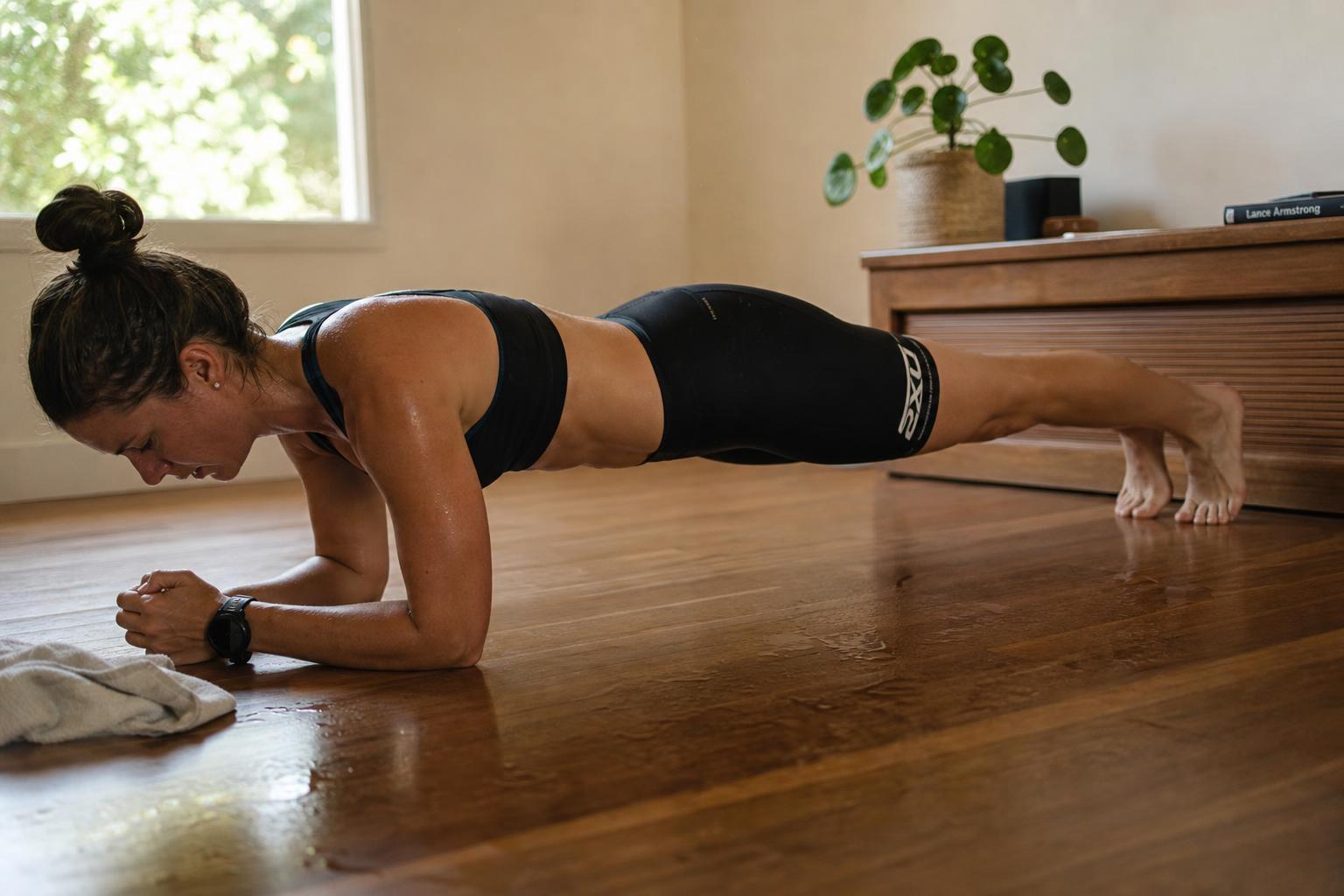
Alongside your weekly session, keep the core work habit. Holding your trunk solid, from armpits to groin, supports your posture in the water, on the bike, and on the run. A few simple exercises are enough: the front plank and side plank cover the essentials. You can slip them in at the end of a session or spread them out over the week. Core work isn't periodized: it remains constant, in the background, all year round. It's a small maintenance habit that pays off big over time.
Who benefits the most from strength training (and what precautions to take)
All triathletes benefit, but certain profiles get a particular boost: women and triathletes over 50, for whom maintaining strength plays an even bigger role in performance and prevention. Under 18, stay cautious; growth plates require extra care.
The universal rule for everyone: progressiveness. Impatience is the leading cause of injury. Your feeling guides the session: if abnormal tension or pain appears, you stop, assess, and resume more gently next time. Strength training complements your overall care, whether handled by your coach, your club, or health professionals.
Strength training integrated into your prep, not tacked onto it
The classic trap: piling a strength session on top of an already packed schedule, without any logic. Well-placed strength integrates into your week and season; it isn't just added randomly. This is exactly the role of Coach Kona: your program combines swimming, cycling, running, strength training, and recovery, evolving session by session based on your constraints and goals. Your strength session falls at the right time, dosed to serve your disciplines without penalizing them. To dive deeper into the fundamentals, check out the Free triathlon course.
100% dedicated to triathlon, personalized, for €29.99/month. You can start with a free trial week to see how your strength training truly integrates into your preparation.
Become the triathlete you want to be.
Frequently Asked Questions
Your strength, integrated into your triathlon plan.
Coach Kona places your strength session at the perfect time, dosed to serve your swimming, biking, and running without hindering them.
Try Coach Kona for free