Complete Guide · April 2026 · 18 min read
Triathlon gear (2026): gear up right, from beginner to high-end
You want to gear up smartly for your triathlon: without breaking the bank, without buying useless stuff, and without regretting your choices.
This guide covers everything: swimming, cycling, running, nutrition, and accessories. With concrete recommendations for every budget point. A belief we share at Coach Kona: gear helps you perform, but it's the triathlon training that makes the difference.
Our gear analysis method
For each gear category, we apply the exact same evaluation grid. The goal is to help you prioritize your purchases, not to buy everything all at once. Each evaluation table is hidden by default, click to reveal it.
- Performance impact: differentiated between short and long distance
- Safety utility: what is essential to train and race safely
- Comfort and consistency: what promotes training consistency
- Investment level: rated from 1 to 5, depending on cost and durability
- Available ranges: entry, mid-range, and high-end
- Distance relevance: short vs. long distance
🎯 Why gear up properly in triathlon?
Triathlon is a demanding discipline. Three chained sports, transitions to manage, huge energy expenditure. In this context, gear plays a real role, provided you understand what it truly brings to the table.
A direct impact on your performance
In swimming, a good neoprene wetsuit improves your buoyancy and reduces water drag. On the bike, an aerodynamic position can save you several minutes over 40 km. Running in shoes adapted to your stride preserves your energy for the final kilometers.
A factor for comfort and consistency
Performance in triathlon is built over time. Uncomfortable gear means sabotaged workouts, pain setting in, eroding motivation. Gearing up properly also means training better, more often, and longer.
A role in injury prevention
Triathlon taxes the body intensely and repeatedly. Inadequate gear accentuates biomechanical strain: bad cycling posture, insufficient running cushion, chafing in the water.
Do I need to buy everything right away?
No. And that's probably the most important piece of advice in this article. Start with the essentials, observe what's truly holding you back, then invest in a targeted manner. Every purchase should answer a concrete need, not a desire to look good on the starting line.
🎽 General gear for the triathlete
The essentials: trisuit + GPS watch + race belt. Add the rest progressively based on your needs.
Some gear items aren't tied to any particular discipline. They accompany you from transition to the finish line, and sometimes even in daily training.
The trisuit
It's the core piece of your outfit. A trisuit is worn for all three disciplines without changing clothes: designed to dry quickly, offer minimal protection in the saddle, and not hinder your running stride.
| Range | Example product | Indicative price |
|---|---|---|
| Entry (~€50) | ~€50 | |
| Mid-range (~€120) | ~€120 | |
| High-end (~€230) | ~€230 |
The GPS watch and heart rate monitor
A central tool to track your training, analyze performance, and progress methodically. The optical wrist sensor is handy for daily wear; the chest strap remains more accurate during competition.
| Range | Example product | Indicative price |
|---|---|---|
| Entry (~€250) | ~€250 | |
| Mid-range (~€450) | ~€450 | |
| High-end (~€600+) | ~€600+ |
Anti-chafe cream
Small purchase, big impact. Long distances cause chafing on the thighs, armpits, neck. A suitable cream prevents irritation and allows you to finish the race without major discomfort.
| Range | Example product | Indicative price |
|---|---|---|
| Entry (~€3) | ~€3 | |
| Mid-range (~€12) | ~€12 | |
| High-end (~€18) | ~€18 |
The race belt
Mandatory in races. Worn on the back for the bike, turned to the front for the run. Simple purchase, low cost, maximum utility.
| Range | Example product | Indicative price |
|---|---|---|
| Entry (~€5) | ~€5 | |
| Mid-range (~€10) | ~€10 | |
| High-end (~€20) | ~€20 |
Multisport sunglasses
Protect your eyes from wind, sun, and insects, especially during the bike and run legs. Lightweight model, secure fit, effective UV protection.
| Range | Example product | Indicative price |
|---|---|---|
| Entry (~€25) | ~€25 | |
| Mid-range (~€80) | ~€80 | |
| High-end (~€180) | ~€180 |
Transition bag and dry bag
A well-organized bag saves you precious seconds in transition. A dry bag protects your belongings in open water environments or bad weather.
| Range | Example product | Indicative price |
|---|---|---|
| Entry (~€20) | ~€20 | |
| Mid-range (~€50) | ~€50 | |
| High-end (~€90) | ~€90 |
Gloves and compression arm sleeves (optional)
Arm sleeves are great on the bike in cool weather. Cycling gloves cushion vibrations and protect in case of a crash. Secondary purchases, to consider once the basics are covered.
| Range | Example product | Indicative price |
|---|---|---|
| Entry (~€15) | ~€15 | |
| Mid-range (~€35) | ~€35 | |
| High-end (~€55) | ~€55 |
🏊 Swimming: technique before technology
The essentials: swim goggles + neoprene wetsuit (mandatory in cold water) + safety buoy if you train in open water. Technique matters more than the rest.
In triathlon, swimming is the discipline where equipment matters the least. Better technique will save you far more time than high-end goggles. Having said that, a few pieces of gear make a real difference.
Swim goggles
The essential accessory. In open water, favor mirrored or tinted lenses to handle glare. In a pool, clear lenses are fine.
| Range | Example product | Indicative price |
|---|---|---|
| Entry (~€10) | ~€10 | |
| Mid-range (~€35) | ~€35 | |
| High-end (~€60) | ~€60 |
The swim cap
Mandatory in races, usually provided by the organization. For training, a basic silicone cap does the job. In cold water, opt for a neoprene cap.
| Range | Example product | Indicative price |
|---|---|---|
| Entry (~€5) | ~€5 | |
| Mid-range (~€12) | ~€12 | |
| High-end (~€25) | ~€25 |
The neoprene wetsuit
The most impactful gear in swimming. It improves buoyancy, reduces water drag, and retains heat. Mandatory below 16°C (60.8°F), allowed up to 24.5°C (76.1°F).
| Range | Example product | Indicative price |
|---|---|---|
| Entry (~€150) | ~€150 | |
| Mid-range (~€300) | ~€300 | |
| High-end (~€600+) | ~€600+ |
Swim training accessories
These tools aren't used in races. They serve to help you progress in the pool by targeting specific aspects of your technique.
| Accessory | Main utility | Investment |
|---|---|---|
| Pull-buoy | Arm work, body positioning | 1/5 (~€10-20) |
| Paddles | Strength and pull technique | 1/5 (~€8-15) |
| Front snorkel | Technique without head rotation | 1/5 to 2/5 (~€25-40) |
| Kickboard | Isolated leg work | 1/5 (~€8-15) |
| Short fins | Speed, core, coordination | 2/5 (~€30-60) |
| Range | Example product | Indicative price |
|---|---|---|
| Entry (~€30) | ~€30 | |
| Mid-range (~€55) | ~€55 | |
| High-end (~€80) | ~€80 |
The safety buoy (open water)
Mandatory in certain events, essential for open water training. It doesn't drag, fastens around your waist, and makes you visible.
| Range | Example product | Indicative price |
|---|---|---|
| Entry (~€15) | ~€15 | |
| Mid-range (~€25) | ~€25 | |
| High-end (~€40) | ~€40 |
Neoprene socks and gloves (temperature dependent)
Optional but useful in cold water (under 16-18°C / 60-64°F). Socks protect your feet on rocky beaches and limit heat loss.
| Range | Example product | Indicative price |
|---|---|---|
| Entry (~€20) | ~€20 | |
| Mid-range (~€35) | ~€35 | |
| High-end (~€55) | ~€55 |
🚴 Cycling: the most strategic leg
The essentials: a reliable bike + approved helmet + clipless shoes/pedals + repair kit. The power meter, carbon wheels, and indoor trainer come next.
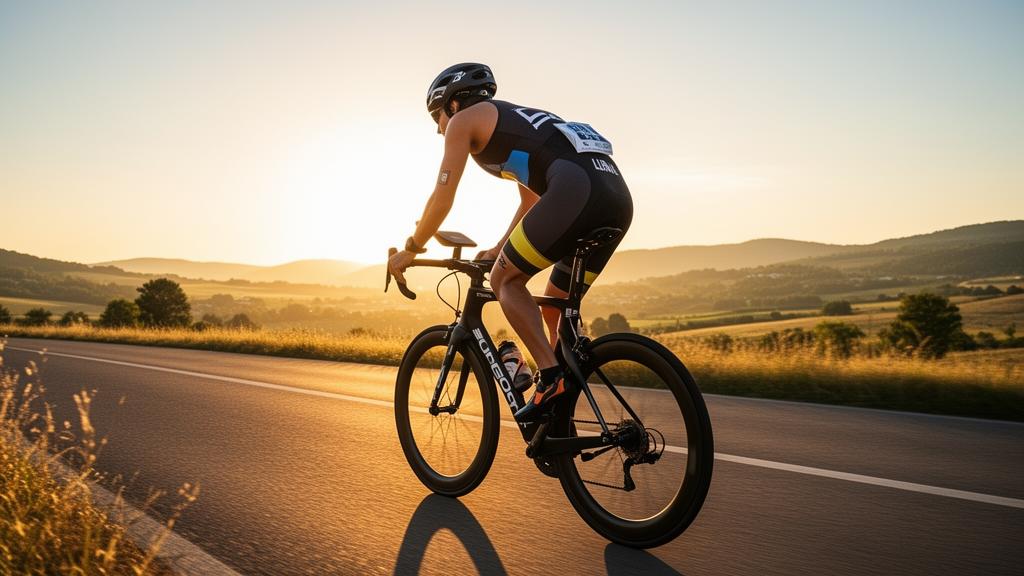
Cycling accounts for about 50% of the race time in a triathlon. It's the leg where equipment has the most direct impact on performance, and also where investments can escalate very fast.
The bike
Road bike or TT bike? For a beginner, a good road bike is more than adequate. A well-adjusted bike tailored to your body will always beat a poorly fitted high-end bike.
| Range | Example product | Indicative price |
|---|---|---|
| Entry (~€800) | ~€800 | |
| Mid-range (~€2,500) | ~€2,500 | |
| High-end (~€4,500+) | ~€4,500+ |
The helmet
Mandatory in races, CE (or equivalent) approved. Aero helmets reduce drag and can save you several watts with no extra effort.
| Range | Example product | Indicative price |
|---|---|---|
| Entry (~€50) | ~€50 | |
| Mid-range (~€120) | ~€120 | |
| High-end (~€300) | ~€300 |
Clipless shoes and pedals
An inseparable system. Improves pedaling efficiency by allowing you to pull up on the pedal stroke. Most used systems: Shimano SPD-SL, Look Keo, Time XPRO.
| Range | Example product | Indicative price |
|---|---|---|
| Entry (~€120) | ~€120 (set) | |
| Mid-range (~€280) | ~€280 (set) | |
| High-end (~€700+) | ~€700+ (set) |
The ergonomic saddle
A poorly fitted saddle causes pains that ruin your training and racing. In triathlon, the position is more aggressive than classic road cycling: short-nosed saddles are often recommended.
| Range | Example product | Indicative price |
|---|---|---|
| Entry (~€40) | ~€40 | |
| Mid-range (~€120) | ~€120 | |
| High-end (~€200+) | ~€200+ |
The power meter
The benchmark tool to pace your cycling efforts accurately. Where heart rate suffers from lag, power output gives instant feedback.
| Range | Example product | Indicative price |
|---|---|---|
| Entry (~€350) | ~€350 | |
| Mid-range (~€500) | ~€500 | |
| High-end (~€800+) | ~€800+ |
The bike GPS computer
Displays real-time data: speed, power, heart rate, maps. At Coach Kona, we recommend the Garmin Edge line, the market standard.
| Range | Example product | Indicative price |
|---|---|---|
| Entry (~€180) | ~€180 | |
| Mid-range (~€350) | ~€350 | |
| High-end (~€650) | ~€650 |
The indoor trainer
Allows you to train on your own bike without bad weather or traffic contraints. Direct drive models are more accurate and quieter.
| Range | Example product | Indicative price |
|---|---|---|
| Entry (~€200) | ~€200 | |
| Mid-range (~€600) | ~€600 | |
| High-end (~€1,100+) | ~€1,100+ |
Wheels
The default wheels that come with the bike are perfectly fine to start. Aero deep-section rims cater more to experienced triathletes on flat and less windy courses.
| Range | Example product | Indicative price |
|---|---|---|
| Standard wheels | Included with bike | — |
| Aero wheels | ~€1,000-1,500 / pair | |
| Disc wheel | ~€1,800+ |
Aero bars
Allows you to adopt an aero stance on the bike, reducing frontal area drag. On a road bike, clip-on aero bars attach to the handlebars. Noticeable impact starting from a 40km draft-legal race.
| Range | Example product | Indicative price |
|---|---|---|
| Entry (~€50) | ~€50 | |
| Mid-range (~€120) | ~€120 | |
| High-end (~€280+) | ~€280+ |
Repair kit, pump, and inner tubes
Essential. Fixing a flat without a repair kit is a DNF (Did Not Finish). Bare minimum: two inner tubes, tire levers, patches, pump or CO2 cartridges.
| Range | Example product | Indicative price |
|---|---|---|
| Entry (~€15) | ~€15 | |
| Mid-range (~€35) | ~€35 | |
| High-end (~€60) | ~€60 |
Bike hydration (bottles, cages, aero systems)
For a sprint, a classic bottle works fine. As soon as you hit half or Ironman, aero systems let you drink without losing your tuck or speed.
| Range | Example product | Indicative price |
|---|---|---|
| Entry (~€15) | ~€15 | |
| Mid-range (~€45) | ~€45 | |
| High-end (~€90) | ~€90 |
Bike fitting
This isn't a product, it's an investment in longevity. A bike fit optimizes your position on the bike: power, comfort, injury prevention. Recommended as soon as you invest in a bike over €1,500.
| Type of fitting | Description | Indicative price |
|---|---|---|
| Basic fitting | Handlebar, saddle, cleat adjustments | ~€80-120 |
| Full fitting | 3D analysis, biomechanics, video | ~€200-350 |
| Triathlon specific fitting | Aero posture on TT frame or aero bars | ~€250-400 |
🏃 Running: lightness, comfort, and consistency
The essentials: training shoes adapted to your stride + elastic laces. That's all you need for your first triathlon.
Running comes last when your body is already quite depleted. Comfort, cushioning, and injury prevention are the absolute priorities.
Training shoes
The number one investment in running. Must fit your stride, body type, and training volume. Don't use your race day carbon shoes to train: they aren't meant to last long.
| Range | Example product | Indicative price |
|---|---|---|
| Entry (~€60) | ~€60 | |
| Mid-range (~€130) | ~€130 | |
| High-end (~€170+) | ~€170+ |
Racing shoes
Engineered to run fast on D-Day, not for longevity. Carbon-plated models offer superior energy return. Keep them in the box for races or specific tempo long runs.
| Range | Example product | Indicative price |
|---|---|---|
| Entry non-carbon (~€100) | ~€100 | |
| Mid-range (~€180) | ~€180 | |
| High-end (~€250+) | ~€250+ |
Technical socks
Often overlooked, yet decisive. A bad pair of socks on a long distance guarantees blisters. Avoid cotton at all costs.
| Range | Example product | Indicative price |
|---|---|---|
| Entry (~€5) | ~€5 | |
| Mid-range (~€18) | ~€18 | |
| High-end (~€25) | ~€25 |
Elastic laces
A tiny detail that changes everything in transition. Allows you to slide your feet in without stopping. Guaranteed time saver in T2. Almost mandatory from your first race on.
| Range | Example product | Indicative price |
|---|---|---|
| Entry (~€3) | ~€3 | |
| Mid-range (~€8) | ~€8 | |
| High-end (~€15) | ~€15 |
Running apparel (shorts, t-shirt, visor / cap)
Lightweight, breathable, non-irritating. Your trisuit often covers this part anyway. If you run in separate gear in training, favor moisture-wicking technical fabrics.
| Range | Example product | Indicative price |
|---|---|---|
| Entry (~€25) | ~€25 (set) | |
| Mid-range (~€60) | ~€60 (set) | |
| High-end (~€120+) | ~€120+ (set) |
The nutrition belt and armband
Essential from the half-triathlon onward. Carries gels, bars, and flasks directly on your person during the race.
| Range | Example product | Indicative price |
|---|---|---|
| Entry (~€10) | ~€10 | |
| Mid-range (~€35) | ~€35 | |
| High-end (~€55) | ~€55 |
Compression calf sleeves and knee sleeves (optional)
Calf sleeves favor venous return and reduce muscle vibrations. Knee bands are great if you have joint vulnerabilities to prevent flare-ups.
| Range | Example product | Indicative price |
|---|---|---|
| Entry (~€15) | ~€15 | |
| Mid-range (~€35) | ~€35 | |
| High-end (~€55) | ~€55 |
🍌 Nutrition and complementary accessories
The essentials: energy gels + isotonic drinks. Always test everything in training before using it on race day.
Nutrition is often referred to as triathlon's fourth discipline. The goal is simple: maintain your energy level from start to finish, without shocking your digestive system on D-Day.
Energy gels
The gel is the standard fuel in triathlon: compact, fast to ingest, effective. Drink one every 30 to 45 minutes starting on the bike. Check if your gel is isotonic (requires no water) or not.
| Range | Example product | Indicative price |
|---|---|---|
| Entry (~€1.20 / gel) | ~€1.20 / gel | |
| Mid-range (~€2.50 / gel) | ~€2.50 / gel | |
| High-end (~€3.50 / gel) | ~€3.50 / gel |
Energy bars and fruit purees
Easier to tolerate digestively than gels. Perfect during the bike segment where chewing is viable. They allow you to mix up texture during long hauls.
| Range | Example product | Indicative price |
|---|---|---|
| Entry (~€0.80 / bar) | ~€0.80 / bar | |
| Mid-range (~€2.00 / bar) | ~€2.00 / bar | |
| High-end (~€3.00 / ea) | ~€3.00 / ea |
Isotonic and electrolyte drinks
They simultaneously replace water and electrolytes (sodium, magnesium, potassium) lost via sweat. Powders or drop-in electrolyte tablets are convenient to dose.
| Range | Example product | Indicative price |
|---|---|---|
| Entry (~€15 / kg) | ~€15 / kg | |
| Mid-range (~€30 / kg) | ~€30 / kg | |
| High-end (~€50 / kg) | ~€50 / kg |
Salt capsules
Over long distances or in high heat, sodium losses can be massive. Particularly vital on an Ironman or in hot climates.
| Range | Example product | Indicative price |
|---|---|---|
| Entry (~€5) | ~€5 / tube | |
| Mid-range (~€20) | ~€20 / 100 caps | |
| High-end (~€30) | ~€30 / 30 caps |
Caffeine and supplements (optional)
The most effective legal ergogenic aid in endurance sports. Improves alertness and lowers the perception of effort. Only to be used toward the end of the race, and only if you tested it in training.
| Range | Example product | Indicative price |
|---|---|---|
| Entry (~€1.50 / gel) | ~€1.50 / gel | |
| Mid-range (~€2.80 / gel) | ~€2.80 / gel | |
| High-end (~€3.80 / gel) | ~€3.80 / gel |
Bento box and bike nutrition storage
Straps onto the top tube or between aero bars. Stores your gels, bars, and salt capsules within easy reach during the ride. Mandatory from the half-triathlon distance for an autonomous nutrition strategy.
| Range | Example product | Indicative price |
|---|---|---|
| Entry (~€10) | ~€10 | |
| Mid-range (~€25) | ~€25 | |
| High-end (~€50+) | ~€50+ |
🛒 Where to buy and how to save money?
Buy new or used?
Used is a great option for some gear, as long as you know what to avoid.
| Gear | Used: ok? | Reason |
|---|---|---|
| Bike | Yes, with mechanical check | Check frame, drivetrain, brakes |
| Neoprene wetsuit | Yes, if no tears/glue marks | Check for waterproofness & elasticity |
| Indoor trainer | Yes | Low wear if well maintained |
| Wheels | Yes, check trueness | Have them checked by a mechanic |
| Helmet | No | A crashed helmet loses all protection |
| Running shoes | No | Cushioning adapts to another runner's stride |
| Bike shoes | Yes if precise fit | Check the soles and straps |
Where to find the best deals?
- Specialized sites: Alltricks, TriShop, Probikeshop (frequent sales)
- Reliable second hand: Troc Vélo, Facebook marketplace, local Tri groups
- Entry-level new bounds: Decathlon is still the benchmark for cheap but reliable starts
- Clearance sales: enduro-season (September-October) = up to 40% off on bikes and wetsuits
Should you rent your gear for your first race?
| Gear | Rental: relevant? | Where to rent |
|---|---|---|
| Neoprene wetsuit | Yes | Local tri clubs, Decathlon |
| Road bike | Yes for a first triathlon | Local bike rental shops, clubs |
| TT bike | No (too technical) | — |
Pro tip: join regional triathlon Facebook groups and Discord channels. Athletes upgrading their gear frequently resell high-end setups at great prices. That's where you score the best hauls.
❓ FAQ: answers to common questions
How much does a full triathlon equipment cost?
| Level | Included gear | Estimated budget |
|---|---|---|
| Beginner (first sprint) | Basic road bike, trisuit, helmet, goggles, running shoes | ~€800-1,500 |
| Intermediate (half) | Mid-range bike, wetsuit, GPS watch, power meter | ~€3,000-6,000 |
| Expert (Ironman) | TT bike, aero wheels, indoor trainer, bike fitting, full nutrition setup | ~€8,000-15,000 + |
What is the best gear for a first triathlon?
The essential starter pack:
- Trisuit
- CE-approved helmet
- Road bike (even a basic one)
- Clipless shoes + pedals
- Swim goggles + cap
- Race belt
- Elastic laces
- Bike repair kit
- Safety buoy (if training in open water)
Do I need a triathlon bike or is a road bike enough?
For 90% of beginners and intermediate triathletes, a road bike is perfectly fine. The TT bike starts turning relevant only when aiming for an age-group podium. Master your road bike first.
Can I rent my gear to avoid spending too much?
Yes, and it's heavily recommended for a first triathlon. A neoprene wetsuit leases for €50-€80 instead of the typical €150-€600 retail cost. Inquire through local triathlon clubs.
What gear is mandatory in a triathlon?
- CE-approved helmet: mandatory on the bike section as soon as you grab your bike.
- Race bib: provided by the organizer, usually worn facing forward during the run.
- Swim cap: provided by the competition, identifies your wave.
- Neoprene wetsuit: mandatory if water drops below 16°C (60.8°F).
📊 Global summary table
Overview of all gear components addressed in this article. Use it to prioritize your buys based on your ongoing situation.
| Gear | Discipline | Priority | Entry-level price | Entry-level product | Mid-range price | Mid-range product | High-end price | High-end product |
|---|---|---|---|---|---|---|---|---|
| Trisuit | General | Essential | ~€50 | ~€100 | ~€200 | |||
| GPS Watch | General | Essential | ~€150 | ~€350 | ~€700 | |||
| Race belt | General | Essential | ~€5 | ~€10 | ~€15 | |||
| Swim goggles | Swimming | Essential | ~€10 | ~€25 | ~€50 | |||
| Swim cap | Swimming | Essential | ~€5 | ~€10 | ~€15 | |||
| Neoprene wetsuit | Swimming | Essential | ~€150 | ~€400 | ~€800 | |||
| Safety buoy | Swimming | Essential | ~€15 | ~€25 | ~€40 | |||
| Bike | Cycling | Essential | ~€800 | ~€2,500 | ~€6,000+ | |||
| Helmet | Cycling | Essential | ~€50 | ~€120 | ~€300 | |||
| Clipless shoes + pedals | Cycling | Essential | ~€120 | ~€250 | ~€500 | |||
| Repair kit | Cycling | Essential | ~€15 | ~€30 | ~€60 | |||
| Ergonomic saddle | Cycling | Essential | ~€40 | ~€120 | ~€300 | |||
| Bike GPS computer | Cycling | Essential | ~€180 | ~€350 | ~€700 | |||
| Bike hydration | Cycling | Essential | ~€15 | ~€35 | ~€80 | |||
| Training shoes | Running | Essential | ~€60 | ~€130 | ~€220 | |||
| Elastic laces | Running | Essential | ~€3 | ~€7 | ~€12 | |||
| Energy gels | Nutrition | Essential | ~€1.00 / gel | ~€1.80 / gel | ~€2.50 / gel | |||
| Isotonic drinks | Nutrition | Essential | ~€15 / kg | ~€30 / kg | ~€50 / kg | |||
| Anti-chafe cream | General | Recommended | ~€3 | ~€10 | ~€20 | |||
| Multisport sunglasses | General | Recommended | ~€25 | ~€80 | ~€200 | |||
| Transition bag | General | Recommended | ~€20 | ~€60 | ~€120 | |||
| Training accessories (paddles, pull-buoy) | Swimming | Recommended | ~€30 | ~€60 | ~€100 | |||
| Indoor trainer | Cycling | Recommended | ~€200 | ~€600 | ~€1,500 | |||
| Aero bars | Cycling | Recommended | ~€50 | ~€150 | ~€400 | |||
| Power meter | Cycling | Recommended | ~€350 | ~€700 | ~€1,500 | |||
| Bike fitting | Cycling | Recommended | ~€80 | ~€200 | ~€400 | |||
| Technical socks | Running | Recommended | ~€5 | ~€15 | ~€25 | |||
| Running apparel | Running | Recommended | ~€25 | ~€70 | ~€150 | |||
| Nutrition belt | Running | Recommended | ~€10 | ~€25 | ~€50 | |||
| Racing shoes | Running | Recommended | ~€100 | ~€180 | ~€280 | |||
| Bars / purees | Nutrition | Recommended | ~€0.80 / ea | ~€1.50 / ea | ~€2.50 / ea | |||
| Bento box | Nutrition | Recommended | ~€10 | ~€25 | ~€50 | |||
| Salt capsules | Nutrition | Recommended | ~€5 | ~€12 | ~€25 | |||
| Gloves / sleeves | General | Optional | ~€15 | ~€35 | ~€70 | |||
| Neoprene socks | Swimming | Optional | ~€20 | ~€45 | ~€80 | |||
| Aero / disc wheels | Cycling | Optional | ~€1,000 | ~€2,000 | ~€3,500+ | |||
| Compression sleeves | Running | Optional | ~€15 | ~€35 | ~€70 | |||
| Caffeine (gels) | Nutrition | Optional | ~€1.50 / gel | ~€2.20 / gel | ~€3.00 / gel |
🏁 The gear doesn't make the triathlete, it reveals them
You now have a complete overview of triathlon gear: what's essential, what's useful, what can wait.
The most vital rule of this article is: prioritize. Start with what yields the most impact for your current level. Start investing slowly, as you progress and spot where your true needs lie.
Every purchase should bring you closer to your goal, not just fill up your garage.
The best gear is the one you master, you use regularly, and that lets you train without injuries. True performance springs from that, not from a 5,000-euro bike gathering dust.
Test, tweak, invest later.
Join Coach Kona and grab a training plan entirely tailored to your fitness, goals, and current equipment.
Also discover
Triathlon training
Build a custom plan and improve sustainably across all three disciplines.
Triathlon strength training
Strengthen the muscles engaged in swimming, cycling, and running to lower injury risks.
Free triathlon course
Learn everything about gear setups and best practices, module by module.
The right gear is a good start. The right plan is what actually drives you forward.
Coach Kona analyzes your level, goals, and equipment to build your very own custom triathlon training plan. Every session counts.
Discover Coach Kona